Latent Variable Models
Published on Sunday, 31-08-2025
(Adopted from MIT 6.S191)
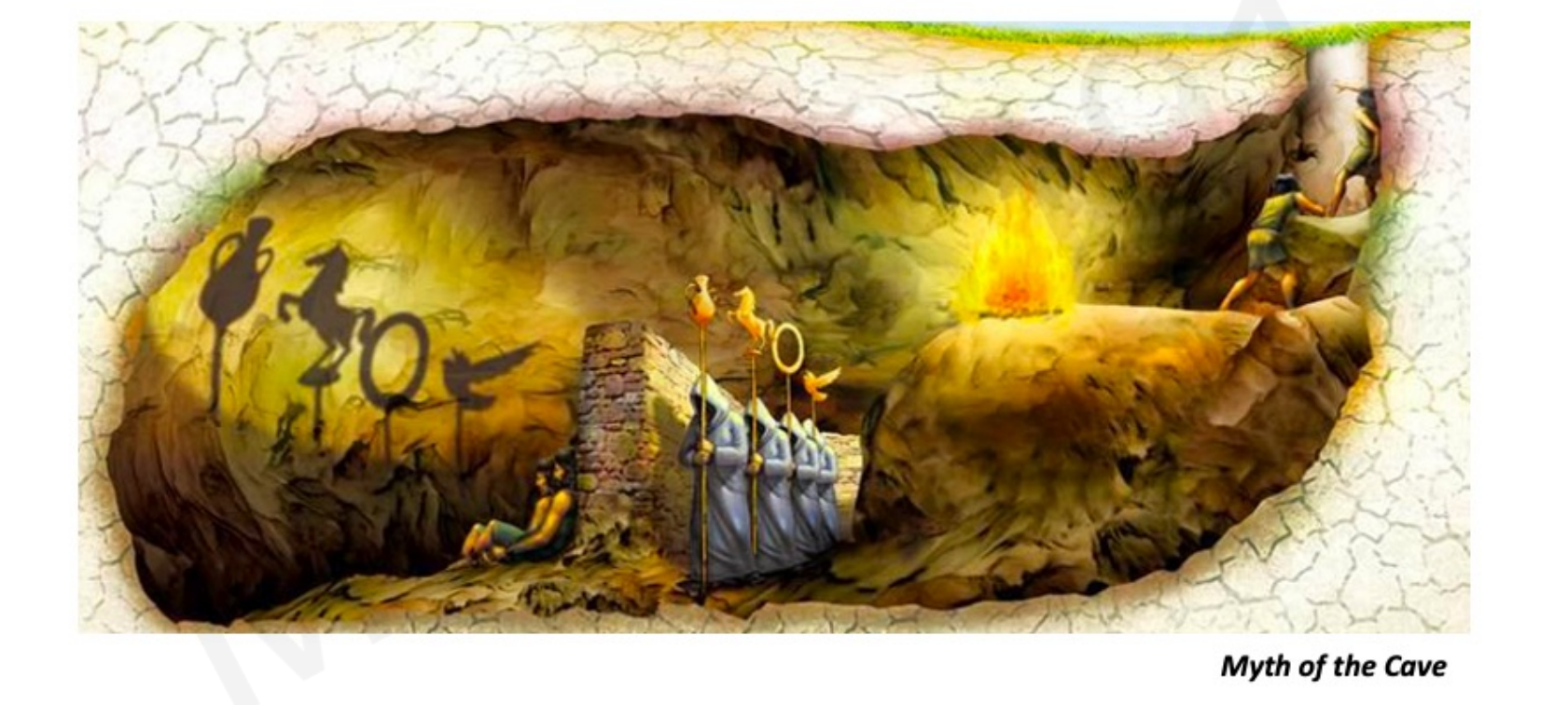
🌌 Latent Variable Models & Autoencoders: Learning the Hidden Causes of Data
🔮 Introduction: What We See vs. What’s Hidden
Think about handwriting. When you see a digit like “7,” you see 784 pixels (28×28 image). But beneath the pixels are hidden factors:
- the identity of the digit,
- the angle of writing,
- the pen thickness,
- the writer’s style.
These hidden factors are latent variables — they’re not directly observed, but they generate the data we see.
👉 Latent Variable Models (LVMs) are about discovering these hidden causes. They are the foundation of Generative AI, because they let us understand, compress, and create data.
🎯 Supervised vs. Unsupervised Learning
Before diving deeper, let’s place LVMs in the ML landscape.
- Supervised learning: you get input–output pairs . Example: predict house price given size & location.
- Unsupervised learning: you only have inputs . Example: discover that some houses cluster into “luxury” vs “budget.”
Latent variable models live in the unsupervised world. They don’t just cluster; they explain data with hidden variables that we can’t see but can infer.
🌀 Generative Modeling: The Mathematical View
A generative model learns how data is produced. Instead of just saying “this is a 7,” it asks: what hidden variables caused this 7 to look this way?
Formally:
- : latent variables (hidden causes).
- : prior distribution over latent space (often Gaussian).
- : likelihood of observing data given latent .
By modeling this, we can:
- Debias: remove unwanted hidden factors (like gender in embeddings).
- Detect anomalies: data that doesn’t fit the latent structure stands out.
- Generate new samples: by sampling a new and decoding it.
🧩 Autoencoders: A Practical Latent Variable Model
The Autoencoder (AE) is one of the simplest ways to learn latent representations.
How It Works
- Encoder: squashes input into a low-dimensional code .
- Decoder: tries to reconstruct from .
- Loss: minimize reconstruction error.
The bottleneck forces the network to learn a compressed representation. If it can reconstruct well, then must capture the important patterns in .
🔍 Intuition: Autoencoder as Nonlinear PCA
- PCA reduces dimensionality by finding the most “important” directions.
- Autoencoders do the same but nonlinearly.
- This means they can capture curved manifolds (like digit shapes), not just straight directions.
🛠️ Building an Autoencoder in PyTorch
Let’s train an AE on MNIST:
import torch
import torch.nn as nn
import torch.optim as optim
from torchvision import datasets, transforms
from torch.utils.data import DataLoader

# Dataset
transform = transforms.ToTensor()
train_data = datasets.MNIST(root="./data", train=True, download=True, transform=transform)
train_loader = DataLoader(train_data, batch_size=128, shuffle=True)

# Autoencoder Model
class Autoencoder(nn.Module):
    def __init__(self):
        super().__init__()
        self.encoder = nn.Sequential(
            nn.Flatten(),
            nn.Linear(784, 128), nn.ReLU(),
            nn.Linear(128, 32)   # latent code
        )
        self.decoder = nn.Sequential(
            nn.Linear(32, 128), nn.ReLU(),
            nn.Linear(128, 784), nn.Sigmoid()
        )
    def forward(self, x):
        z = self.encoder(x)
        x_hat = self.decoder(z)
        return x_hat.view(-1, 1, 28, 28), z

model = Autoencoder()
optimizer = optim.Adam(model.parameters(), lr=1e-3)
criterion = nn.MSELoss()

# Training loop
for epoch in range(5):
    for x, _ in train_loader:
        x_hat, _ = model(x)
        loss = criterion(x_hat, x)
        optimizer.zero_grad()
        loss.backward()
        optimizer.step()
    print(f"Epoch {epoch+1}, Loss={loss.item():.4f}")
🎨 Visualizing the Latent Space
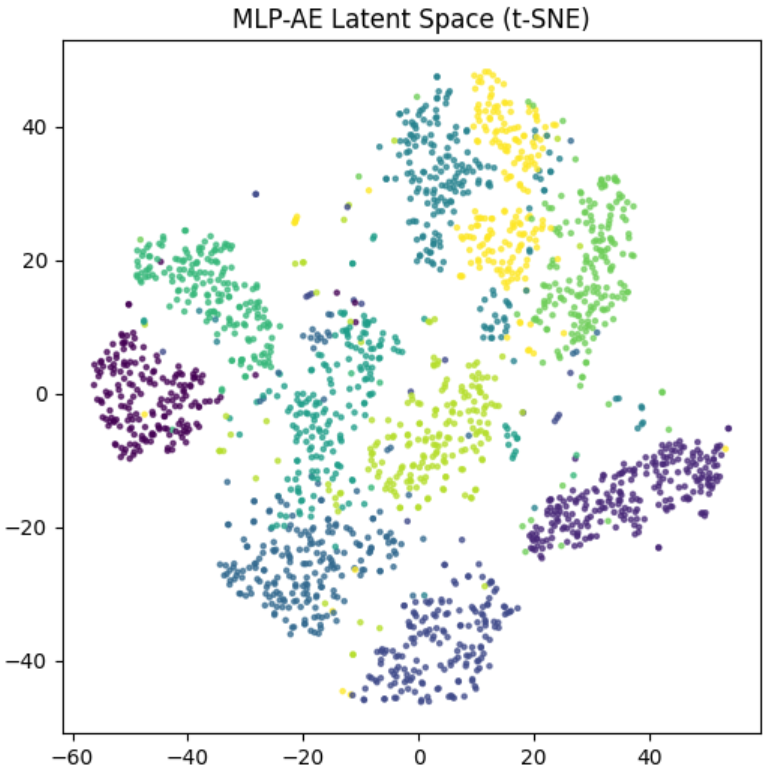
Once trained, the encoder maps digits into a latent space. Let’s see what it looks like with t-SNE:
from sklearn.manifold import TSNE
import matplotlib.pyplot as plt

latents, labels = [], []
model.eval()
with torch.no_grad():
    for x, y in train_loader:
        _, z = model(x)
        latents.append(z)
        labels.append(y)

import numpy as np
latents = torch.cat(latents).numpy()
labels = torch.cat(labels).numpy()

z2d = TSNE(n_components=2).fit_transform(latents)
plt.scatter(z2d[:,0], z2d[:,1], c=labels, cmap="tab10", s=5)
plt.colorbar()
plt.title("Latent Space Visualization (MNIST Autoencoder)")
plt.show()
👉 You’ll see clusters: all “3”s are near each other, “7”s cluster separately. The AE has discovered structure without labels!
⚡ Can Autoencoders Generate New Data?
This is where things get tricky.
We might try:
with torch.no_grad():
    z = torch.randn(16, 32)  # random latent samples
    samples = model.decoder(z).view(-1,1,28,28)
But usually, the results look blurry or meaningless.
😬 The Problem: Why Autoencoders Struggle
Autoencoders are trained only to reconstruct data they’ve seen. They don’t learn a nice, smooth latent distribution.
- Encoder maps real inputs into some weird shape in latent space.
- If we sample random outside that shape, the decoder has no idea what to do.
So while AEs are excellent compressors, they’re poor generators.
🔑 Enter Variational Autoencoders (VAEs)
To fix this, VAEs make the latent space probabilistic.
- Encoder outputs a distribution (mean & variance).
- A regularization term (KL divergence) pushes latent codes toward a Gaussian.
This way, random samples from decode into realistic data. 👉 VAEs are true generative models, unlike vanilla AEs.
🌟 Applications of Autoencoders
- Dimensionality reduction: nonlinear PCA.
- Anomaly detection: high reconstruction error = anomaly.
- Image denoising: train with noisy inputs, reconstruct clean outputs.
- Feature extraction: latent vectors as embeddings.
✅ Conclusion
Latent Variable Models let us peek beneath the surface of data.
- Autoencoders give us a practical way to learn compressed, meaningful codes.
- They reconstruct well but struggle with generation.
- VAEs (and later GANs, Diffusion Models) build on this idea to generate new, realistic samples.
👉 Think of Autoencoders as microscopes: they help us see the hidden structure. 👉 But if we want to create, we need probabilistic LVMs like VAEs.
\